Starting a New Leadership Role: The First 90 Days, From the Inside Out
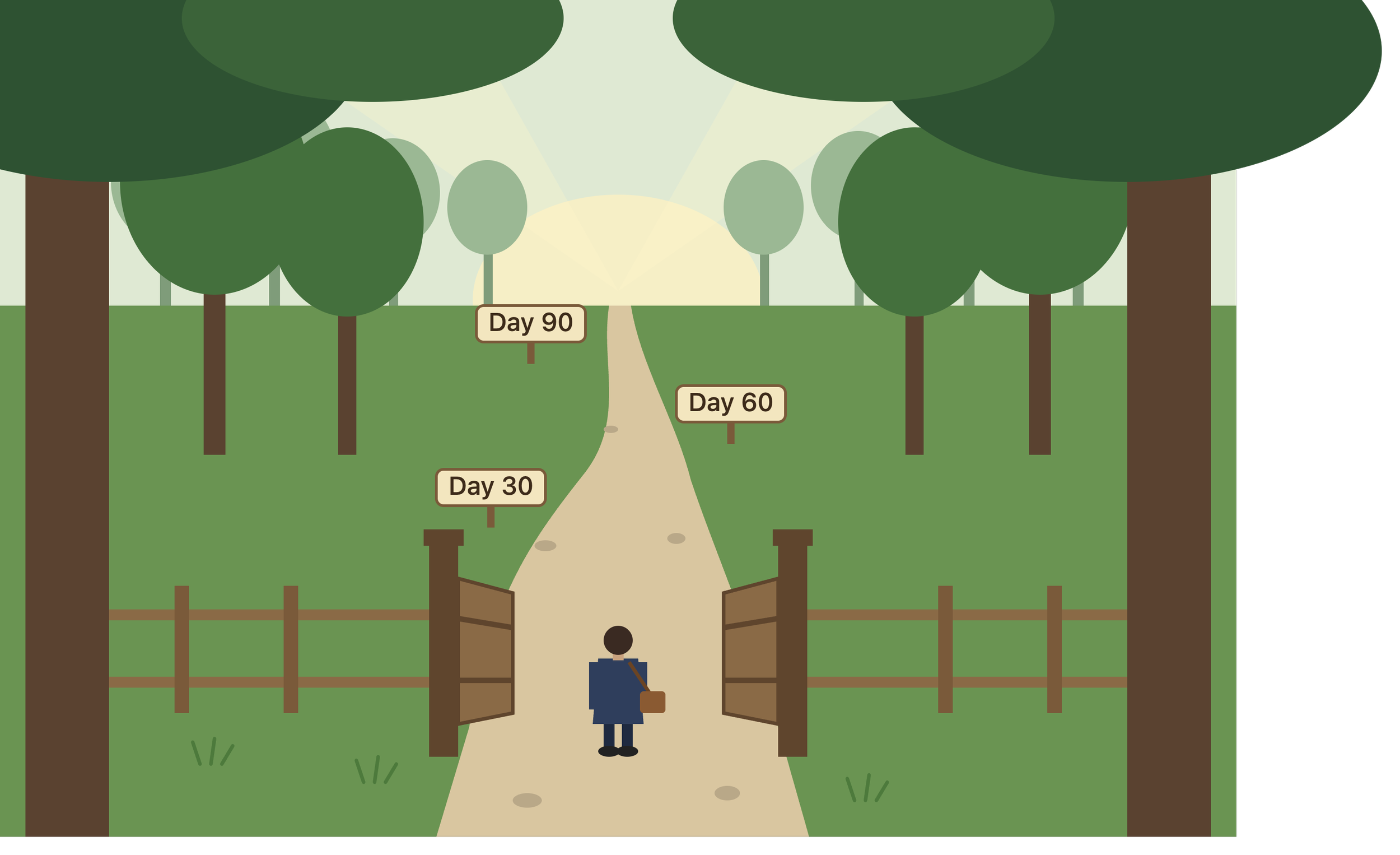
Starting a new leadership/manager role has a 30, 60, 90 path with phases.
Most advice about the first 90 days starts outside you: learn the org chart, win early results, meet the stakeholders. That framing was popularized by Michael Watkins in The First 90 Days, and it's useful. But the leaders who settle into a new role well often begin somewhere else, with themselves.
Days 1-30: Start with who you want to be
Before you map the gaps in your new role, picture your best self in it. What does it look like on an ordinary Tuesday when you're leading well? What do you want people to say about working with you a year from now?
Starting with the vision, not the gaps, matters. Richard Boyatzis's research on intentional change suggests that exploring your ideal self first helps sustain motivation, while a focus on deficits can trigger defensiveness. A list of what you don't yet know can leave you anxious. A picture of who you're becoming gives you something to move toward.
In this first month:
Name your values in the role. What will you protect, even under pressure?
Notice your inner critic. Treat yourself as you would a colleague who is learning. Research by Juliana Breines and Serena Chen suggests that self-compassion increases motivation to improve after a failure, so it isn't going easy on yourself.
Build in a pause. A few seconds before you respond to a tense moment is often enough to choose your response.
Days 31-60: Listen before you decide
Now turn outward. Your job is to understand the people and the system you've inherited before you change them.
Hold one-on-one conversations. Ask what's working, what's getting in the way, and what they need from you.
Listen for what's unspoken. Notice energy, hesitation, and what people skip over.
Learn the history. Every team has a story about previous leaders. It shapes how they read you.
How you respond when people speak up shapes whether they keep doing it. Amy Edmondson's research on psychological safety suggests that teams where people feel safe raising concerns and mistakes learn faster.
Listening is not the same as agreeing or polling. You are gathering information, and the decisions are still yours.
Days 61-90: Take ownership and shape direction
By now you have enough to start leading, not just learning.
Share a clear direction. Say what you've heard, what you see, and where you're headed.
Define roles and expectations. Meta-analytic research links role ambiguity with weaker performance and lower job satisfaction. Clarity is a kindness, not just a tidy-up.
Make a few decisions and own them, with the reasoning explained. Don't wait for certainty or consensus.
Delegate on purpose. What got you promoted may not be what the role needs now.
Keep looking after the person doing the leading
A new role can swallow sleep, movement, and rest first, and they're what steady, clear leadership runs on. Research by Christopher Barnes and colleagues suggests that sleep-deprived leaders are seen as less charismatic and less able to inspire. Protect these early, before the pressure builds.
Questions to try
Who do I want to be in this role, beyond what I want to accomplish?
What am I being too hard on myself about?
Who haven't I really listened to yet?
What decision have I been postponing?
What one habit of looking after myself will I protect through the next 90 days?
New to a bigger role? I'd be glad to talk. Learn about the Inside-Out Leadership Development Program or book a conversation. You may also like Hit a Bump at Work?. For a deeper look at nine ways of leading, see The Science of Leadership by Margaret Moore and Jeffrey Hull (2025).
Sources
Barnes, C. M., Guarana, C., Nauman, S., & Kong, D. T. (2016). Sleep deprivation and charismatic leadership. Journal of Applied Psychology.
Boyatzis, R. E., & Akrivou, K. (2006). The ideal self as the driver of intentional change. Journal of Management Development.
Breines, J. G., & Chen, S. (2012). Self-compassion increases self-improvement motivation. Personality and Social Psychology Bulletin.
Edmondson, A. (1999). Psychological safety and learning behavior in work teams. Administrative Science Quarterly.
Moore, M., & Hull, J. (2025). The Science of Leadership. Berrett-Koehler.
Tubre, T. C., & Collins, J. M. (2000). Jackson and Schuler (1985) revisited: A meta-analysis of role ambiguity, role conflict, and job performance. Journal of Management.
Watkins, M. D. (2003; updated 2013). The First 90 Days. Harvard Business Review Press.